Can a 3% Margin Business Earn 20% ROCE? Here’s the math
Yes. A 3% margin can produce roughly 20% ROCE when each rupee of average capital employed generates about ₹6.70 of annual income. Here is the arithmetic.

Yes. A business with a 3% EBIT margin can earn roughly 20% ROCE if each rupee of average capital employed produces about ₹6.70 of annual income. The shorthand calculation is simple:
3% margin × 6.7 times capital turnover = 20.1% ROCE
Altys’ FY26 data contains a close real-world version. AWL Agri Business reported a 2.76% EBIT margin, capital turnover of 6.71 times and ROCE of 18.52% for the year ended 31 March 2026.
The headline rounds those figures to 3% and 20%. The exact calculation is:
2.76% × 6.71 = 18.52%
The margin looks thin. The return does not. The missing variable is speed.
First, see why the formula works
ROCE measures the operating profit produced by the capital used in a business:
ROCE = EBIT / average capital employed
In Altys data, average capital employed is the average equity plus the average borrowings across the current and year-ago balance-sheet dates. Using an average pairs a full year of EBIT with the capital base that supported it through the year.
Now split that ratio into two smaller ratios.
EBIT margin = EBIT / total income
Capital turnover = total income / average capital employed
Multiply them:
(EBIT / total income) × (total income / average capital employed)
The two total-income terms cancel. What remains is:
EBIT / average capital employed = ROCE
This is not a different definition of ROCE. It is the same ratio opened up so we can see what is driving it.
One part tells us how much operating profit the business keeps from each rupee of income. The other tells us how much income the business produces from each rupee of capital.
Now put ₹100 into the business
The AWL example becomes easier to understand if we start with ₹100 of capital.
Step 1: Turn the capital into income
Capital turnover of 6.71 times means ₹100 of average capital employed supported about ₹671 of annual income.
₹100 × 6.71 = ₹671 of income
Step 2: Apply the margin
An EBIT margin of 2.76% means the business retained ₹2.76 of operating profit from every ₹100 of income.
Apply that margin to ₹671:
₹671 × 2.76% = ₹18.52 of EBIT
Step 3: Compare profit with the original capital
The business produced ₹18.52 of EBIT from ₹100 of capital.
₹18.52 / ₹100 = 18.52% ROCE
That is how a margin of roughly 3% can produce a return of roughly 20%. The business does not keep much on each pass. It puts the same capital through many passes.
Five FY26 examples from Altys data
The same multiplication appears across very different business models.
The table starts with the Nifty 500 membership dated 9 August 2026. It uses consolidated FY26 results for the year ended 31 March 2026, keeps non-financial businesses with EBIT margins below 8% and ROCE above 15%, and selects five neutral illustrations.
| Company | EBIT margin | Capital turnover | ROCE | Total-income growth | ROCE after a hypothetical 1 pp margin drop |
|---|---|---|---|---|---|
| AWL Agri Business | 2.76% | 6.71x | 18.52% | 17.58% | 11.81% |
| Nykaa | 4.45% | 4.42x | 19.65% | 26.05% | 15.23% |
| Kalyan Jewellers | 6.22% | 5.71x | 35.51% | 42.72% | 29.80% |
| NBCC (India) | 7.51% | 4.48x | 33.67% | 7.52% | 29.20% |
| Apar Industries | 7.61% | 4.10x | 31.18% | 22.95% | 27.08% |
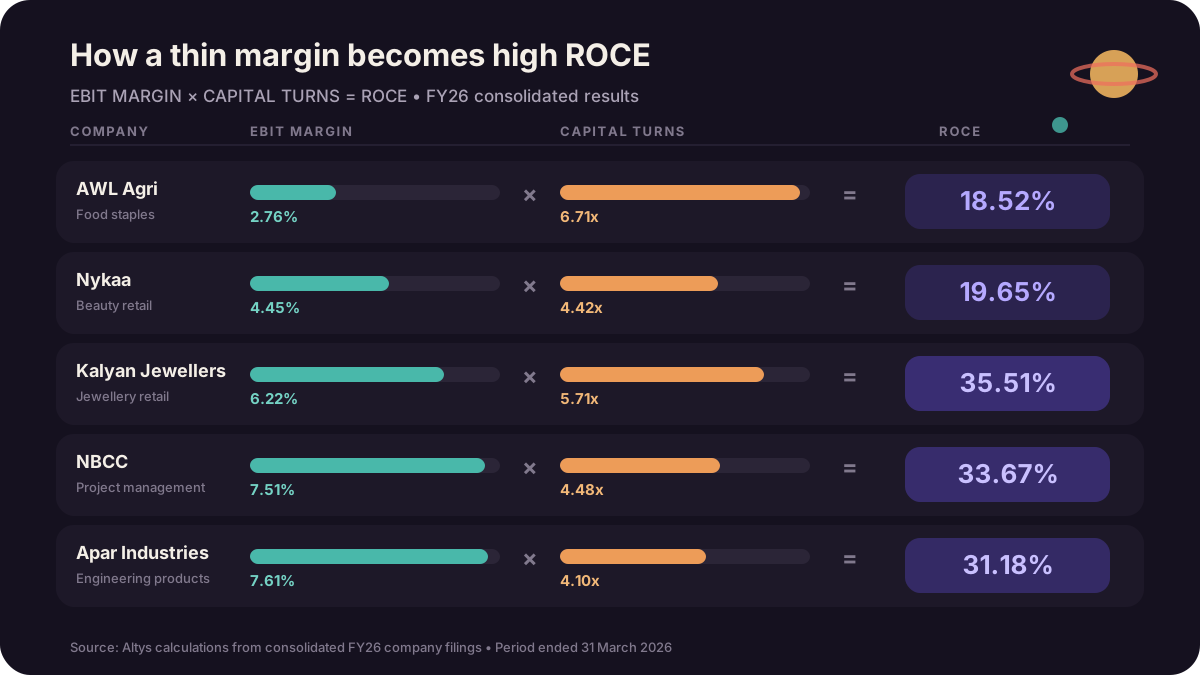
Source: Altys calculations from consolidated company filings for the year ended 31 March 2026. Nifty 500 membership is as of 9 August 2026. Figures are rounded. The one-percentage-point margin stress is a mechanical illustration that holds capital turnover unchanged. It is not a forecast. Public source links appear below.
These companies are not peers, and this is not a ranking. Jewellery, beauty retail, engineering products, project management and food staples have different economics. They simply show that a high return can be assembled from different combinations of margin and speed.
Two businesses can reach 20% in opposite ways
Consider two hypothetical businesses using ₹100 of capital.
| Business A | Business B | |
|---|---|---|
| EBIT margin | 20% | 3% |
| Capital turnover | 1.0x | 6.7x |
| Implied ROCE | 20% | 20.1% |
Business A earns a great deal on each rupee of income but moves its capital only once. Business B earns very little on each rupee but moves its capital about 6.7 times.
The final ROCE is almost identical. The operating risks are not.
Business A may depend more on pricing power, intellectual property, a brand or a scarce service. Business B may depend more on volume, procurement, inventory movement, distribution, supplier terms and tight cost control.
The return number shows the outcome. The decomposition shows the machine that produced it.
The catch: speed magnifies mistakes
Fast capital turnover is powerful because it multiplies a thin margin. That multiplication works in both directions.
Return to AWL’s FY26 figures. If the EBIT margin fell by one percentage point, from 2.76% to 1.76%, while turnover remained 6.71 times, the implied ROCE would become:
1.76% × 6.71 = 11.81%
One percentage point of margin would remove about 6.71 percentage points of ROCE.
That is a large change in the final return from what sounds like a small change in the margin. It happens because every margin movement is multiplied by the number of capital turns.
The same arithmetic appears in the table’s last column. At 4.10 times turnover, a one-point margin change moves implied ROCE by about 4.10 points. At 5.71 times turnover, it moves ROCE by about 5.71 points.
Low margin is therefore not automatically a weakness. It is a smaller error budget.
One number, three different trajectories
The latest snapshot becomes more useful when we look at how its two parts changed.
AWL: speed rose, but the margin moved the return
AWL’s capital turnover increased from 4.88 times in FY24 to 5.85 times in FY25 and 6.71 times in FY26. Its EBIT margin moved from 1.96% to 3.64%, then back to 2.76%.
ROCE moved from 9.58% to 21.26% and then 18.52%. Capital moved faster each year, yet the return fell in FY26 because less operating profit remained from each rupee of income.
Nykaa: margin and speed improved together
Nykaa’s EBIT margin rose from 2.37% in FY24 to 2.94% in FY25 and 4.45% in FY26. Capital turnover improved from 3.36 to 3.74 and then 4.42 times.
ROCE increased from 7.96% to 11.01% and then 19.65%. Both parts of the equation contributed.
Kalyan Jewellers: faster turns did much of the work
Kalyan Jewellers reported capital turnover of 3.53 times in FY24, 4.58 times in FY25 and 5.71 times in FY26. Its margin moved from 5.97% to 5.24% and then 6.22%.
ROCE rose from 21.10% to 23.97% and then 35.51%. The margin improved in FY26, but the multi-year rise in capital velocity was also central to the expansion.
What the equation still cannot tell you
The math explains how the return was produced. It does not tell us whether the stock is attractive or whether the return can persist.
Four questions remain.
What keeps turnover high?
Fast turnover can come from efficient inventory, an asset-light model, customer advances, supplier credit or a combination of them. Read receivables, inventory, payables, debt and operating cash flow to understand what is funding the speed.
Can the margin survive pressure?
A thin spread can be exposed to raw-material costs, freight, discounting, competition, regulation or execution errors. Study the margin through difficult years, not only the latest period.
Is there room to repeat the return?
A company can earn a high return on its current capital and still have limited places to invest the next rupee. Stores, distribution, capacity, product lines and demand determine whether the return can compound through a larger capital base.
What price is the market asking?
ROCE measures business efficiency, not valuation. A strong business can still be priced for an outcome it cannot deliver. Growth, cash conversion, leverage and valuation belong beside the ratio.
The practical takeaway
When a low-margin company reports high ROCE, do not dismiss the margin and do not celebrate the return immediately. Run four checks:
- Multiply margin by capital turnover and identify which part drives the result.
- Stress the margin by one percentage point and see how far implied ROCE moves.
- Check whether inventory, receivables, payables and operating cash support the turnover.
- Ask whether the company can deploy more capital without slowing the turns or compressing the margin.
A 3% margin business can earn 20% ROCE. The math is real. The investment question begins where the multiplication ends.
Public sources
- Apar Industries investor relations and FY26 results
- AWL Agri Business FY26 quarterly and annual results
- Kalyan Jewellers consolidated FY26 NSE filing
- NBCC financial results
- Nykaa consolidated FY26 NSE filing
Related reading:
Frequently asked questions
Can a business with a 3% margin earn 20% ROCE?
Yes. Multiply a 3% EBIT margin by capital turnover of about 6.7 times and the result is roughly 20% ROCE. The business earns little on each rupee of income, but the same capital supports a large volume of income.
How can ROCE be split into margin and capital turnover?
EBIT margin is EBIT divided by total income. Capital turnover is total income divided by average capital employed. Multiply them and total income cancels, leaving EBIT divided by average capital employed, which is ROCE.
Does high capital turnover make a low margin safe?
No. Fast turnover can support a strong return, but it also magnifies margin changes. At 6.7 times turnover, a one-percentage-point fall in margin reduces implied ROCE by roughly 6.7 percentage points if turnover is unchanged.
Does a high ROCE make a stock a good investment?
No. ROCE measures current capital efficiency. It does not establish whether the return is durable, whether cash conversion is healthy, how much capital can be reinvested at that rate or whether the share price already assumes a favourable outcome.
Why are banks and NBFCs excluded from this comparison?
For lenders, deposits and borrowings are operating inputs rather than ordinary financing. EBIT and capital employed therefore do not carry the same meaning, so ROCE and this decomposition are not appropriate for them.