The 1x P/E Illusion: When One-Time Profit Distorts Valuation
A very low P/E can be an accounting snapshot, not a recurring valuation. Separate ongoing earnings from exceptional and discontinued gains first.

A P/E near one can be an accounting snapshot rather than a picture of recurring earnings. If the denominator contains a demerger gain, asset-sale profit or arbitration award, the ratio can look unusually low even though the underlying business did not suddenly become many times more profitable.
The formula is simple:
P/E = share price / earnings per share
The interpretation is not.
Price is observed on a date. Earnings are assembled from a period and an accounting basis. Change that basis from total reported earnings to earnings from continuing operations, and the multiple can change dramatically without the share price moving by one rupee.
Four FY26 examples
The table fixes price at 20 July 2026 and changes only the earnings denominator. “Reported P/E” uses reported trailing EPS. “One-off-aware P/E” uses continuing-operations EPS or an illustrative adjustment for an identified exceptional gain.
| Company | Reported EPS | Reported P/E | One-off-aware EPS | One-off-aware P/E | Main item to inspect |
|---|---|---|---|---|---|
| Kiri Industries | ₹915.55 | 0.45x | ₹71.70 | 5.69x | Arbitration-related exceptional gain |
| Raymond | ₹802.58 | 0.76x | ₹5.05 | 121.24x | Demerger gain in discontinued operations |
| GOCL Corporation | ₹307.02 | 1.31x | ₹6.09 | 65.91x | Profit attributed to discontinued operations |
| Ashoka Buildcon | ₹90.83 | 1.36x | ₹22.32 | 5.54x | Exceptional gain linked to an asset transaction |
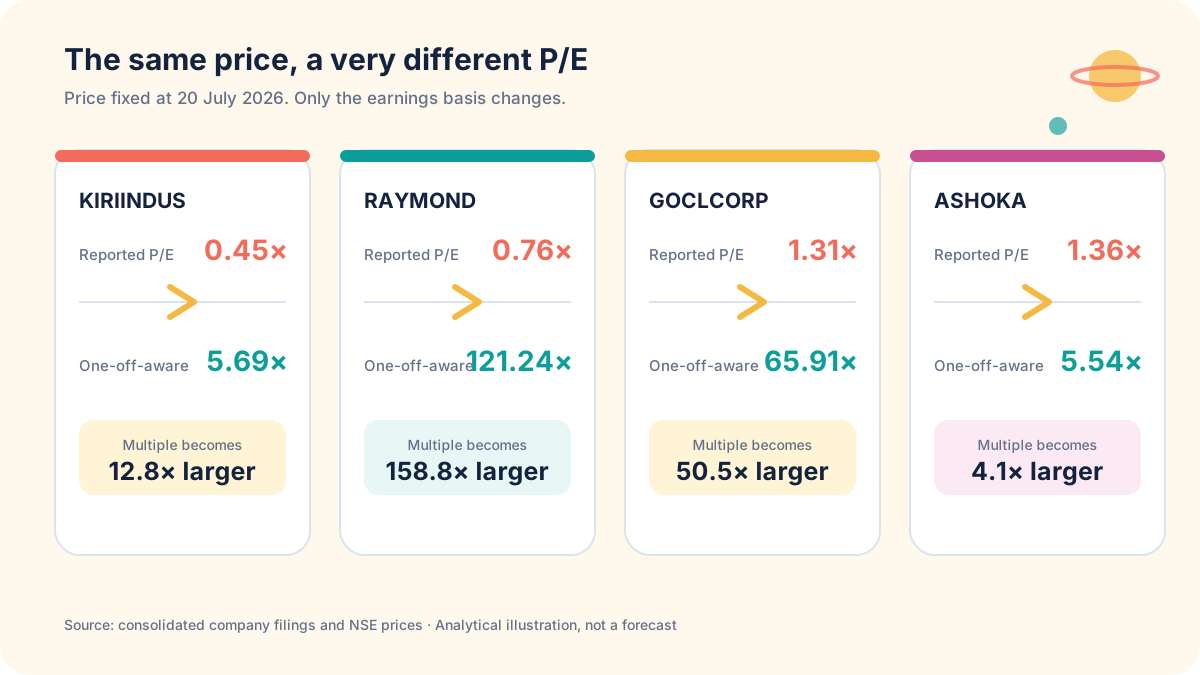
Source: Altys calculations from consolidated company filings and NSE prices. Prices are as of 20 July 2026. Earnings use the latest FY26 information available by that date. The adjusted figures are analytical illustrations, not company guidance or forecasts. Source links appear below.
The range matters. Removing the identified item changed the illustrative multiple by about four times at Ashoka Buildcon, nearly 13 times at Kiri Industries, about 50 times at GOCL Corporation and more than 150 times at Raymond.
That does not make the reported P/E false. It makes the label incomplete.
The denominator can carry an entire corporate event
Raymond is the cleanest illustration of why line-item classification matters. Its FY26 consolidated filing reported about ₹5,308 crore of profit from discontinued operations. The continuing business earned a much smaller amount.
At ₹612.85 per share on 20 July, dividing price by total reported trailing EPS produced a P/E below one. Dividing the same price by continuing-operations EPS produced a multiple above 120.
Both calculations answer a real question:
- Reported P/E asks how price compares with all earnings recognised in that trailing period.
- Continuing P/E asks how price compares with the earnings of operations that remain in the reported business.
For a forward-looking valuation discussion, the second question is usually more relevant. It is still not a forecast. It simply starts with a denominator that better matches the business left behind.
GOCL Corporation shows a similar classification issue. Its FY26 consolidated result included a large share of profit under discontinued operations. A headline EPS figure therefore described the accounting outcome of the year, but not just the ongoing operating base.
Exceptional is not the same as discontinued
Kiri Industries and Ashoka Buildcon require a different judgement.
An exceptional item can remain inside continuing profit. It may arise from a legal award, asset transaction, settlement, impairment or another event that management and auditors present separately because of its size or nature.
That creates three checks:
- What exactly generated the gain? Read the note, not only the face of the income statement.
- How was tax treated? Removing a pre-tax gain from post-tax profit without an associated tax adjustment can create a second distortion.
- Could a similar item recur? An item can be unusual without being impossible to repeat, especially in businesses that regularly monetise assets.
The goal is not to create a perfectly smooth earnings number. It is to understand which part came from the operating engine and which part came from a specific event.
When P/E should disappear altogether
There is another important case. If ongoing EPS is zero or negative, a positive P/E based on a one-time gain can be actively misleading.
A conventional positive P/E has no useful meaning when the recurring denominator is negative. The disciplined response is not to force a number. It is to mark the ratio as not meaningful and examine other evidence.
Useful alternatives include:
- Revenue and operating-profit trends.
- Operating cash flow and working-capital movements.
- Enterprise value relative to sales or operating earnings, when applicable.
- Segment-level profitability.
- The balance sheet before and after the corporate event.
Absence is information. A blank multiple can be more honest than a precise-looking answer built on the wrong denominator.
A five-minute P/E check
Before treating a low P/E as a valuation conclusion, run this sequence:
1. Reconcile EPS to the latest filing
Check whether the number is basic or diluted, standalone or consolidated, and quarterly, annual or trailing. A ratio without a basis is not yet usable.
2. Search for three lines
Look for “exceptional items”, “discontinued operations” and “profit on sale”. Then read the corresponding notes.
3. Rebuild the denominator transparently
Use continuing-operations profit when it is disclosed. For exceptional gains, show the adjustment and its tax treatment. Do not hide judgement inside the final multiple.
4. Check cash
A one-time accounting gain may not produce operating cash flow. Compare profit with cash from operations and, where relevant, investing cash flow from the transaction.
5. Keep both numbers
Reported earnings explain the filed year. A recurrence-aware figure explains the analytical question. Showing both prevents an adjustment from becoming its own black box.
The better question
“What is the P/E?” sounds precise, but it leaves out the most important choice: earnings from what?
A useful valuation process names the denominator, shows the bridge from reported to adjusted earnings, and allows a ratio to be unavailable when the economics do not support it. The arithmetic takes seconds. The value comes from reading what entered the denominator.
Public sources
- Ashoka Buildcon consolidated FY26 NSE filing
- GOCL Corporation consolidated FY26 NSE filing
- Kiri Industries consolidated FY26 NSE filing
- Raymond consolidated FY26 NSE filing
- NSE security-wise price and volume archives
Related reading:
Frequently asked questions
Why can a stock show a P/E of around one?
The earnings denominator may include a large one-time gain, such as a demerger gain, an asset sale or an arbitration award. The reported P/E is mathematically correct, but it may not describe the earnings that can recur.
Should exceptional items always be removed from earnings?
No. The adjustment depends on what happened, whether it belongs to continuing operations, how tax was treated and whether similar items are genuinely recurring. Read the filing note before changing the denominator.
What should I use when reported and recurring P/E are far apart?
Treat the gap as a prompt for deeper work. Compare continuing profit, operating cash flow, segment economics, enterprise-value multiples and the precise filing note rather than relying on one adjusted number.
Does a higher adjusted P/E mean the stock is unattractive?
No. A valuation multiple is not a recommendation. It only describes the relationship between price and a chosen earnings measure, and it must be read alongside growth, quality, risk and business durability.