Profit Positive, Cash Negative: Five FY26 Cases Worth Investigating
Positive profit with negative operating cash flow is a forensic signal, not a verdict. Five FY26 cases show the questions it should trigger.

Positive profit with negative operating cash flow is a signal to investigate, not a conclusion about the company. It means accrual earnings and operating cash moved in opposite directions during the period, so the next task is to explain where the cash was absorbed.
Profit after tax records income and expenses under accrual accounting. Cash from operating activities records the cash consequences after movements in receivables, inventory, payables, advances, contract balances, taxes and other operating items.
The two can diverge sharply even when both statements are correct.
Five consolidated FY26 cases
The table covers five non-financial companies that reported positive trailing profit for the year ended 31 March 2026 and negative consolidated operating cash flow.
| Company | PAT | Operating cash flow | CFO / PAT |
|---|---|---|---|
| G R Infraprojects | ₹905.3 cr | -₹2,811.5 cr | -3.11x |
| Rail Vikas Nigam | ₹874.7 cr | -₹1,893.9 cr | -2.17x |
| Cochin Shipyard | ₹716.5 cr | -₹1,234.1 cr | -1.72x |
| Kaynes Technology | ₹363.7 cr | -₹600.4 cr | -1.65x |
| Inox Wind | ₹406.3 cr | -₹598.1 cr | -1.47x |
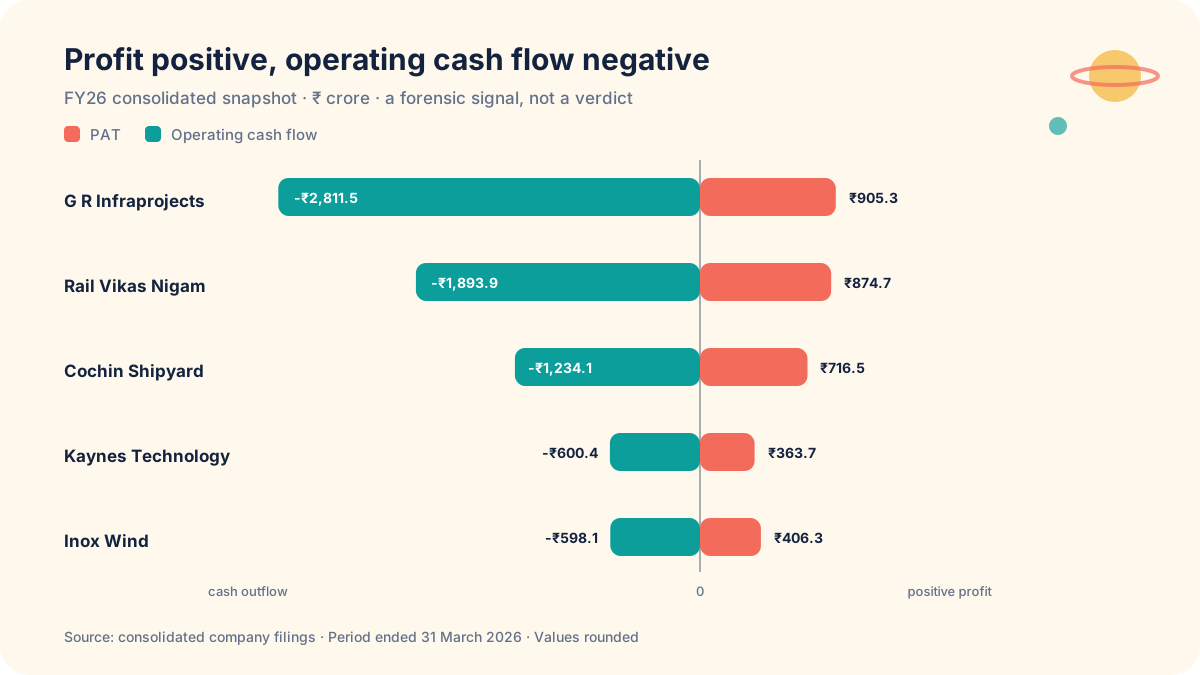
Source: Altys calculations from consolidated company filings for the year ended 31 March 2026. Figures are rounded. CFO/PAT is operating cash flow divided by trailing profit after tax on the same consolidated basis. Source links appear below.
The common pattern is clear. Each company reported positive profit, while operating cash flow moved the other way. The magnitude ranged from negative 1.47 times PAT at Inox Wind to negative 3.11 times at G R Infraprojects.
The causes do not have to be the same.
First, separate timing from economics
A sale can be recorded before the customer pays. A manufacturer can build inventory before shipping it. An infrastructure contractor can recognise revenue as work progresses while cash follows milestone certification. A shipbuilder can carry large project balances over a long delivery cycle.
Those are timing mechanisms. They can create a real gap between profit and cash without making the profit fictional.
The economic question is whether the cash eventually arrives on acceptable terms.
This is why a one-year ratio should lead to a reconciliation rather than a label. Trace the gap through the cash-flow statement and balance sheet:
- Receivables: Did customer credit expand faster than revenue?
- Inventory: Was cash committed to raw materials or finished goods ahead of demand?
- Contract assets and unbilled revenue: Was income recognised before billing milestones were reached?
- Advances and other current assets: Did project or supplier payments move ahead of delivery?
- Payables: Did supplier funding shrink at the same time?
- Taxes and provisions: Did a cash payment relate to profit recognised in another period?
The answer often sits in several lines, not one.
Second, follow the financing cash flow
A company can finish the year with more cash even when operations consumed cash. New debt or equity can fill the gap.
That distinction is easy to miss when the analysis stops at the closing cash balance. In this five-company snapshot, four names also reported positive financing cash flow in FY26:
| Company | Financing cash flow | Net change in cash |
|---|---|---|
| G R Infraprojects | ₹1,522.9 cr | ₹334.3 cr |
| Cochin Shipyard | ₹695.7 cr | -₹211.3 cr |
| Kaynes Technology | ₹1,579.6 cr | ₹62.0 cr |
| Inox Wind | ₹1,557.8 cr | ₹109.8 cr |
| Rail Vikas Nigam | -₹1,619.0 cr | -₹2,571.2 cr |
Source: the same FY26 consolidated cash-flow statements. Positive financing cash flow means a net inflow in the financing section for the year.
This is not automatically negative. A growing business may raise capital before investing in capacity. A project business may borrow against a temporary working-capital build. A company may also refinance on better terms.
But the source of liquidity matters. Cash generated by customers has different economics from cash supplied by lenders or shareholders.
Third, compare the pattern across time
Working capital can reverse. Inventory is sold, receivables are collected and contract milestones are billed. If that happens, a weak cash-conversion year may be followed by a strong one.
Persistent divergence deserves more attention. Useful tests include:
- Add operating cash flow across three to five years and compare it with cumulative PAT.
- Measure receivable and inventory growth against revenue growth.
- Check whether the business repeatedly needs financing inflows to support ordinary operations.
- Separate maintenance investment from expansion investment after operating cash flow.
- Read whether management’s earlier collection or inventory commitments were achieved.
One year shows a condition. A sequence shows a business habit.
Fourth, respect the business model
The same CFO/PAT threshold should not be applied mechanically across sectors.
Long-cycle infrastructure and shipbuilding businesses often carry milestone-based balances. Fast-growing electronics and industrial manufacturers may fund inventory, tooling and customer credit as scale rises. Banks and other lenders have a fundamentally different cash-flow structure, which is why ordinary CFO-based forensic ratios are not directly comparable for financial companies.
Sector context does not erase the cash gap. It changes what a plausible explanation looks like.
When the signal becomes more serious
Negative operating cash flow deserves greater scrutiny when several conditions appear together:
- The pattern persists across multiple years.
- Receivables grow much faster than sales without a clear reason.
- Inventory builds while demand or utilisation weakens.
- Related-party balances or opaque advances become material.
- Financing inflows repeatedly cover operating shortfalls.
- Management explanations change without the expected cash recovery.
- Profit depends heavily on estimates, fair values or exceptional items.
None of these proves misconduct by itself. A cluster of them raises the cost of being wrong and therefore the standard of evidence required.
A practical forensic worksheet
When PAT is positive and CFO is negative, write down six figures for at least three years:
| Profit view | Working-capital view | Funding view |
|---|---|---|
| PAT | Receivables | Operating cash flow |
| EBITDA | Inventory or contract assets | Financing cash flow |
Then answer three questions in plain language:
- What absorbed the cash?
- What event should release it?
- How long can the business fund the gap if that release is delayed?
That turns a screening anomaly into a research plan.
The right conclusion
Profit and cash do not need to match every year. They do need to reconcile over a business cycle.
The useful response to positive PAT and negative CFO is neither comfort nor accusation. It is a dated, company-specific explanation of the working-capital movement, the funding source and the evidence that cash conversion can recover.
Public sources
- G R Infraprojects consolidated FY26 NSE filing
- Rail Vikas Nigam consolidated FY26 NSE filing
- Cochin Shipyard consolidated FY26 NSE filing
- Kaynes Technology consolidated FY26 NSE filing
- Inox Wind consolidated FY26 NSE filing
Related reading:
Frequently asked questions
Can a profitable company have negative operating cash flow?
Yes. Receivables, inventory, contract assets, advances, taxes and other working-capital movements can absorb more cash than the year's accounting profit. The cause and duration determine how the result should be interpreted.
Does negative operating cash flow mean there is fraud?
No. It is a forensic signal, not evidence of misconduct. It becomes more concerning when it persists, lacks a clear operating explanation, depends on repeated external financing or sits beside aggressive accounting judgements.
What is CFO to PAT?
It is cash from operating activities divided by profit after tax for the same period and basis. It helps compare accounting profit with operating cash generation, but one year can be distorted by working-capital timing.
What should I check after finding positive PAT and negative CFO?
Reconcile the cash-flow statement, inspect receivables, inventory and contract balances, compare several years, study financing cash flows and read management's explanation for the working-capital movement.